
What Happened In Venezuela’s Devastating Twin Earthquakes?
Venezuela is grappling with one of the deadliest natural disasters in its recent history after two powerful earthquakes measuring 7.2 and 7.5 magnitude struck the country, killing at least 164 people and injuring 971 others.
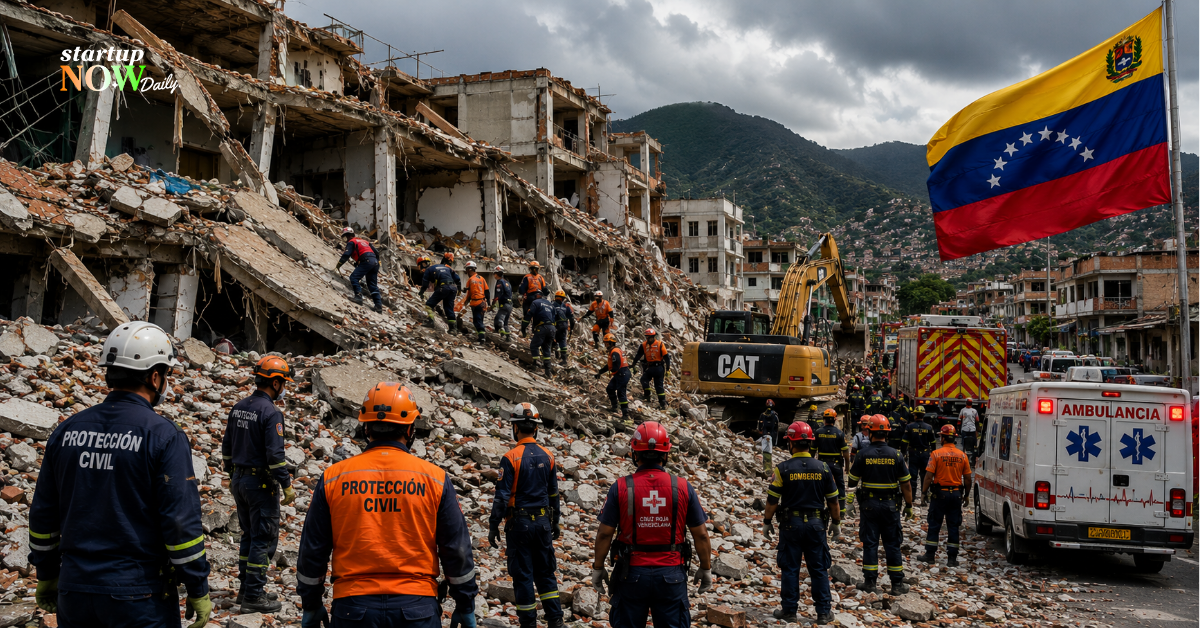
The powerful tremors, which hit on Wednesday evening, caused widespread destruction across several regions, flattening residential buildings, damaging critical infrastructure, and trapping hundreds beneath collapsed structures.
Acting President Delcy Rodriguez confirmed the revised casualty figures on Thursday, warning that the death toll could continue to rise as emergency teams search through the rubble in the country’s worst-affected areas.
The twin earthquakes have triggered one of Venezuela’s largest rescue operations in decades as authorities race against time to locate survivors.
Which Areas Were Worst Affected By The Earthquakes?
The capital city Caracas suffered extensive structural damage, with several residential and commercial buildings collapsing after the powerful tremors.
The neighbouring coastal state of La Guaira, home to the country’s main international airport, emerged as one of the worst-hit regions. Authorities temporarily closed the airport while emergency responders assessed damage and began rescue operations.
Emergency workers continued searching through collapsed buildings overnight as families desperately waited for news of missing relatives.
Residents described scenes of widespread devastation, with roads blocked by debris, damaged buildings, and power outages affecting several neighbourhoods.
Maria Alejandra, who lives near one of the collapsed buildings in Caracas, described the aftermath as resembling “a horror movie,” saying residents had to climb over piles of rubble to escape.
How Extensive Is The Damage?
Authorities say dozens of buildings have collapsed, while hospitals, schools, embassies, and public infrastructure have suffered varying degrees of damage.
The Venezuelan Red Cross confirmed that its headquarters sustained significant structural damage, although rescue teams continue operating across affected regions.
France also reported extensive damage to its embassy building in Caracas.
Schools across the country have been closed for the remainder of the week as engineers inspect public buildings and authorities assess the full extent of structural damage.
Despite the widespread destruction, preliminary assessments suggest that Venezuela’s major oil production infrastructure, including the El Palito refinery and facilities around Lake Maracaibo, has not suffered significant operational damage.
However, industry sources warned that prolonged electricity outages could eventually affect crude oil production.
How Are Rescue Teams Responding?
Search and rescue operations have continued around the clock as emergency personnel work to locate survivors trapped beneath collapsed buildings.
The Venezuelan government has mobilised civil defence teams, firefighters, military personnel, and medical workers while international rescue teams from several countries are expected to arrive to support ongoing operations.
Hospitals across Caracas have activated emergency response protocols, with medical staff asked to extend shifts to accommodate the growing number of injured patients.
Authorities are also conducting damage assessments across multiple states while deploying temporary shelters for displaced residents.
According to opposition leaders, more than 6,600 people were reported missing within hours of the disaster, although official verification remains ongoing.
What Did Experts Say About The Earthquake?
The United States Geological Survey (USGS) warned that the disaster could prove significantly worse than initial casualty estimates.
Using predictive earthquake impact models, the USGS suggested there is a substantial probability that the final death toll could rise into the thousands, with some scenarios indicating fatalities could exceed 10,000 depending on the extent of structural collapses and rescue outcomes.
Aftershocks continued to shake Caracas and surrounding regions throughout the night, raising concerns about additional building collapses and complicating rescue efforts.
Although authorities initially issued a tsunami warning following the earthquakes, it was later withdrawn after experts determined that the threat had passed.
How Has The International Community Responded?
Leaders from several countries, including the United States, Brazil, Spain, El Salvador, and the Dominican Republic, have expressed solidarity with Venezuela and offered humanitarian assistance.
US President Donald Trump said the United States stood ready to assist relief operations.
“The two major earthquakes that just hit the great people of Venezuela are both massive in scale and have left a devastating number of deaths,” Trump said in a social media post.
The US State Department confirmed it is coordinating with Venezuelan authorities to mobilise emergency assistance.
The United Nations Human Rights Mission also urged the Venezuelan government to temporarily lift restrictions on social media platforms, stating that communication during rescue operations had become “a matter of life and death.”
Why Is Venezuela Vulnerable To Major Earthquakes?
Venezuela lies along the boundary between the Caribbean Plate and the South American Plate, making it one of the most seismically active regions in northern South America.
The country has experienced several destructive earthquakes throughout its history, including the devastating 1812 earthquake, which killed an estimated 30,000 people across Caracas and Mérida.
More recently, Caracas was struck by a deadly 6.3 magnitude earthquake in 1967, which remains one of the country’s most significant seismic disasters in modern history.
The latest twin earthquakes once again highlight Venezuela’s vulnerability to large-scale seismic events and the importance of earthquake-resistant infrastructure.
What Happens Next?
Emergency officials remain focused on rescue operations, with the priority shifting toward locating survivors before the window for successful rescues narrows.
Authorities are expected to continue damage assessments over the coming days while restoring electricity, communication networks, transportation infrastructure, and essential public services.
As aftershocks continue and rescue teams work through collapsed structures, the final human and economic impact of one of Venezuela’s most destructive earthquakes in decades is still unfolding.