
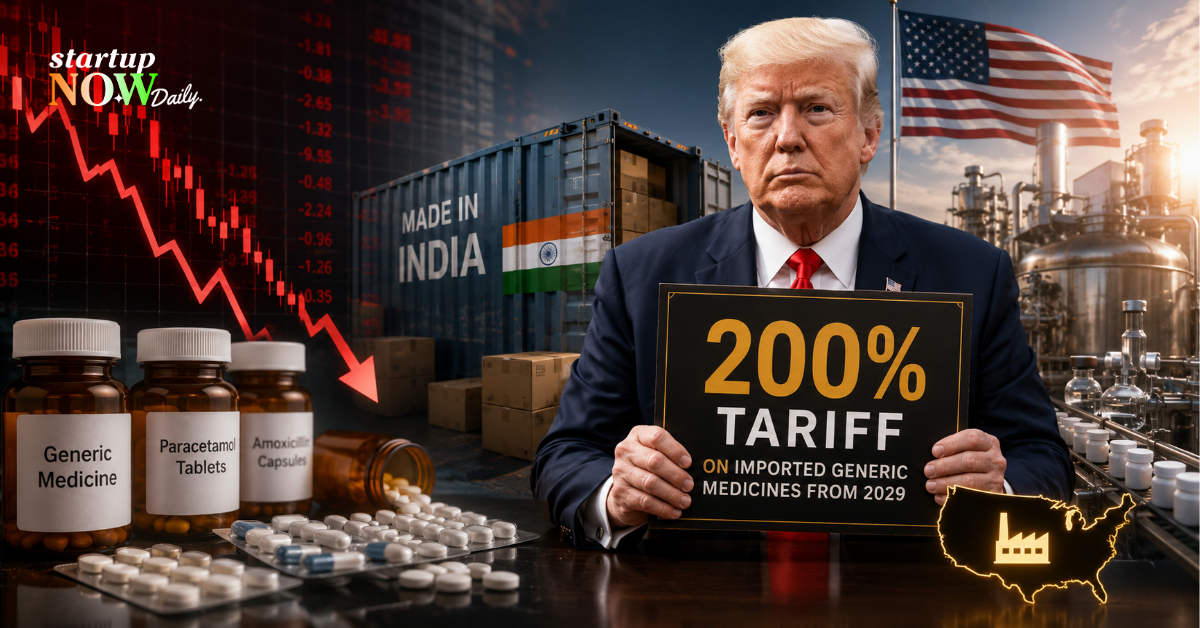
Nifty Pharma Declines as US Signals Steep Tariffs on Generic Medicines from 2028
Indian pharmaceutical stocks came under pressure on Wednesday after US President Donald Trump announced a proposed tariff roadmap for imported generic medicines, warning that generic drug imports could eventually face a 200% tariff as part of his plan to boost pharmaceutical manufacturing in the United States.
The announcement triggered a broad sell-off in Indian pharma shares, with the Nifty Pharma Index falling around 1.6% in early trade, making it the worst performing sectoral index of the day.
While the proposed tariffs would not take effect immediately, investors reacted to concerns over the long-term impact on Indian drugmakers, many of which derive a significant portion of their revenue from the US market.
What Did Trump Announce?
In a post on Truth Social, Trump said that imported generic medicines would continue to enjoy zero tariffs for two years beginning August 1, 2026.
After this transition period, the proposed tariff structure would be:
- 100% tariff from August 1, 2028
- 200% tariff from August 1, 2029
According to Trump, the policy is intended to encourage pharmaceutical companies to establish manufacturing facilities within the United States instead of relying on imported generic medicines.
Companies that fail to invest in US manufacturing infrastructure could face the proposed tariffs once the transition period ends.
However, the proposal has so far been announced only through a social media post, and no formal presidential proclamation or implementation guidelines have yet been issued.
Which Indian Pharma Stocks Were Affected?
The proposed policy weighed heavily on Indian pharmaceutical companies with significant exposure to the US generic medicines market.
Among the major losers:
- Cipla declined around 2.5%
- Lupin fell nearly 2.5%
- Sun Pharmaceutical Industries slipped about 2%
- Dr. Reddy’s Laboratories lost more than 1%
- Aurobindo Pharma
- Zydus Lifesciences
- Alkem Laboratories
- Torrent Pharmaceuticals
also traded lower, falling by up to 2% during early market hours.
Investor concerns stem from the fact that the United States accounts for more than 30% of India’s pharmaceutical exports, making it the country’s largest overseas market for medicines.
India’s Pharma Exports Already Under Pressure
According to data compiled by Pharmexcil using figures from the Directorate General of Commercial Intelligence and Statistics (DGCI&S), India’s pharmaceutical exports reached a record $31.12 billion during FY26, representing annual growth of 2.13%.
However, exports to the United States declined nearly 10% year-on-year to $9.47 billion.
Exports to the broader North American market, including the US, Canada, and Mexico, also declined 7.9% during the financial year.
Industry experts attribute this decline primarily to temporary factors such as inventory corrections, generic price erosion, product cycle timing, and a high base rather than structural weakness in demand.
Can the US Replace Indian Generic Manufacturing?
Several industry experts have questioned whether the United States can realistically build a cost-competitive generic drug manufacturing ecosystem within the proposed two-year timeline.
According to Pharmexcil Chairman Namit Joshi, establishing generic manufacturing facilities requires significant investment, regulatory approvals, and technology transfer, making the timeline difficult to achieve.
He noted that while over $480 billion has already been committed by global pharmaceutical companies for manufacturing investments in the US, these projects primarily focus on patented medicines, which account for only around 10% of prescriptions but nearly 87% of pharmaceutical spending.
In contrast, generic medicines account for approximately 90% of prescriptions but contribute only about 13% of total pharmaceutical spending by value, making large scale investments in domestic generic manufacturing less financially attractive.
Analysts See Limited Immediate Impact
Despite the market reaction, analysts believe the long-term impact on Indian pharmaceutical companies could be less severe than initially feared.
Manufacturing costs in India remain 40% to 60% lower than those in the United States, providing Indian manufacturers with a significant competitive advantage even if tariffs are eventually imposed.
Analysts also pointed out that several Indian pharmaceutical companies already operate through US subsidiaries, and the final tariff mechanism including valuation methodology, product coverage, exemptions, and treatment of companies investing in US manufacturing has yet to be clarified.
In addition, building new pharmaceutical manufacturing facilities in the US typically requires at least two years, followed by another 12 to 15 months for inspections and regulatory approvals before commercial production can begin.
Outlook
While Trump’s announcement has created uncertainty for global generic drug manufacturers, the proposal remains subject to formal policy implementation.
The two-year transition period provides pharmaceutical companies time to evaluate manufacturing strategies, while investors await detailed regulations from the US administration.
Until official rules are released, market volatility in Indian pharma stocks is likely to continue as companies assess the potential implications for one of their most important export markets.