
Why Are Amazon And Flipkart Aggressively Expanding Their Quick Commerce Networks?
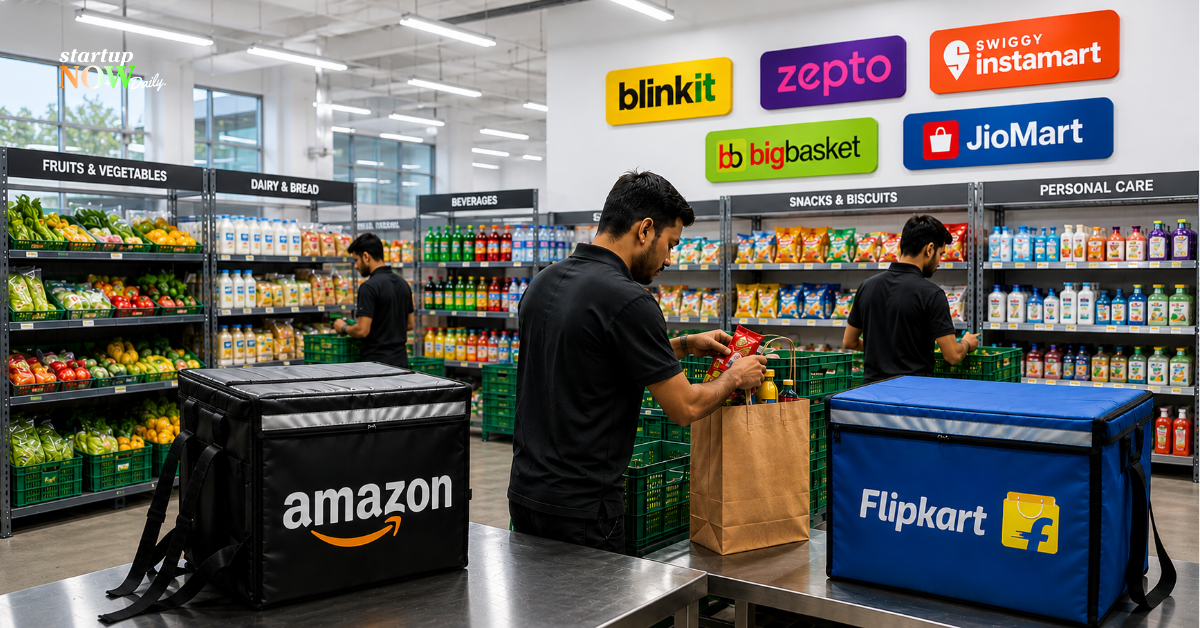
India’s quick commerce sector has entered a new phase of competition as e-commerce giants Amazon and Flipkart ramp up investments in dark stores and micro fulfilment centres to challenge established players including Blinkit, Zepto, Swiggy Instamart, BigBasket and JioMart.
What was once dominated by startup-led grocery delivery platforms has now evolved into a high stakes battle involving the country’s largest technology companies. The latest expansion announcements indicate that infrastructure, delivery speed and geographic reach have become the primary competitive advantages in India’s rapidly growing instant commerce market.
With billions of dollars flowing into logistics infrastructure and fulfilment capabilities, the race is now shifting from customer acquisition to execution at scale.
How Is Flipkart Minutes Expanding Across India?
Flipkart Minutes, the Walmart-owned quick commerce platform, recently crossed the milestone of 1,000 micro fulfilment centres across more than 130 cities and 8,000 PIN codes, less than two years after launching in August 2024.
The company said order volumes have grown fivefold over the past year, driven by aggressive expansion into Tier II and Tier III cities. According to sources, Flipkart Minutes is already on track to surpass 1,500 micro fulfilment centres within the next few months, highlighting the pace at which it is expanding.
The platform also reported a remarkable 42X increase in business across smaller cities while adding more than 90 new cities to its network during the past year.
Consumer preferences are also evolving rapidly. According to Flipkart, Gen Z now represents more than 40% of its customer base, with demand expanding beyond groceries into categories such as electronics, beauty, wellness, personal care and lifestyle products.
What Is Amazon’s Expansion Strategy For Amazon Now?
Amazon has unveiled an equally ambitious roadmap for its quick commerce business, Amazon Now.
During CEO Andy Jassy’s recent visit to India, the company announced plans to expand Amazon Now to more than 300 cities through a network of over 1,000 micro fulfilment centres and 100 Urban Fulfillment Centers.
Currently operating more than 500 fulfilment centres, Amazon intends to double its infrastructure footprint as it accelerates expansion across the country.
The company had previously announced a $300 million investment to strengthen its logistics and fulfilment infrastructure, with a significant portion earmarked for scaling Amazon Now.
Amazon said the platform has become the fastest-growing business unit within its Indian e-commerce operations, with order volumes doubling every quarter since launch. The service now caters to more than 50 million customers across over 15 cities, while Prime members reportedly shop three times more frequently than other users.
Why Have Dark Stores Become The Industry’s Biggest Competitive Advantage?
Dark stores have emerged as the backbone of India’s quick commerce ecosystem.
Unlike traditional warehouses, these compact fulfilment centres are strategically located near residential neighbourhoods, allowing companies to stock high-demand products closer to consumers and complete deliveries within minutes.
As customer expectations increasingly shift towards deliveries in 10 to 30 minutes, companies are investing heavily in denser fulfilment networks that reduce delivery distances and improve operational efficiency.
A larger dark store network enables better inventory management, faster deliveries, higher order fulfilment rates and lower logistics costs, making infrastructure one of the most important competitive differentiators in the industry.
Which Companies Currently Lead India’s Dark Store Race?
Blinkit continues to dominate the dedicated quick commerce market with 2,243 dark stores spread across 243 cities.
Swiggy Instamart and Zepto operate 1,143 and 1,139 dark stores, respectively, while Tata-backed BigBasket has expanded its network to more than 900 dark stores nationwide.
Flipkart Minutes has already crossed the 1,000-centre milestone and is preparing to add hundreds more.
Amazon currently operates more than 500 fulfilment centres, but its planned expansion to over 1,000 centres and 300 cities would give it the largest geographic footprint among dedicated quick commerce players once fully implemented.
How Fast Is Competition Intensifying Across The Sector?
The pace of expansion has accelerated dramatically over the past year.
Blinkit added 942 new dark stores during FY26 alone, while Swiggy Instamart and Zepto expanded their networks by 122 and 110 stores, respectively.
Against this backdrop, Amazon and Flipkart’s aggressive expansion plans highlight the increasing capital intensity of the business as global technology companies directly challenge startup-led incumbents.
Recent market data also suggests competitive dynamics are shifting. According to an Entrackr report, Swiggy Instamart’s share of orders among the three largest quick commerce platforms declined from 34.3% in FY24 to 20.9% in FY26, reflecting growing competitive pressure.
How Is JioMart Following A Different Quick Commerce Model?
Unlike most competitors, Reliance-owned JioMart is not relying primarily on dedicated dark stores.
Instead, it leverages Reliance Retail’s extensive physical store network to fulfil quick commerce orders.
During Reliance Industries’ recent Annual General Meeting, the company revealed that its quick commerce operations now span more than 3,100 stores across 1,200 cities and 5,100 PIN codes.
This asset-light model allows JioMart to utilise existing retail infrastructure while reducing the need for large-scale investments in dedicated dark store facilities.
What Does This Mean For India’s Quick Commerce Industry?
India’s quick commerce market has rapidly evolved from a grocery delivery business into a broader retail ecosystem encompassing electronics, fashion, beauty, healthcare, home essentials and premium consumer products.
As Amazon and Flipkart dramatically scale their infrastructure alongside Blinkit, Zepto, Swiggy Instamart, BigBasket and JioMart, the industry is entering its most competitive phase yet.
With seven major players competing aggressively for market share, fulfilment density, customer retention and delivery speed are becoming the defining factors for long-term success.
While the market continues to grow rapidly, analysts believe the increasing capital requirements and intense competition could eventually trigger consolidation within the sector.
For now, however, India’s quick commerce race is accelerating faster than ever, with every major player investing heavily to secure leadership in one of the country’s fastest-growing digital commerce segments.