
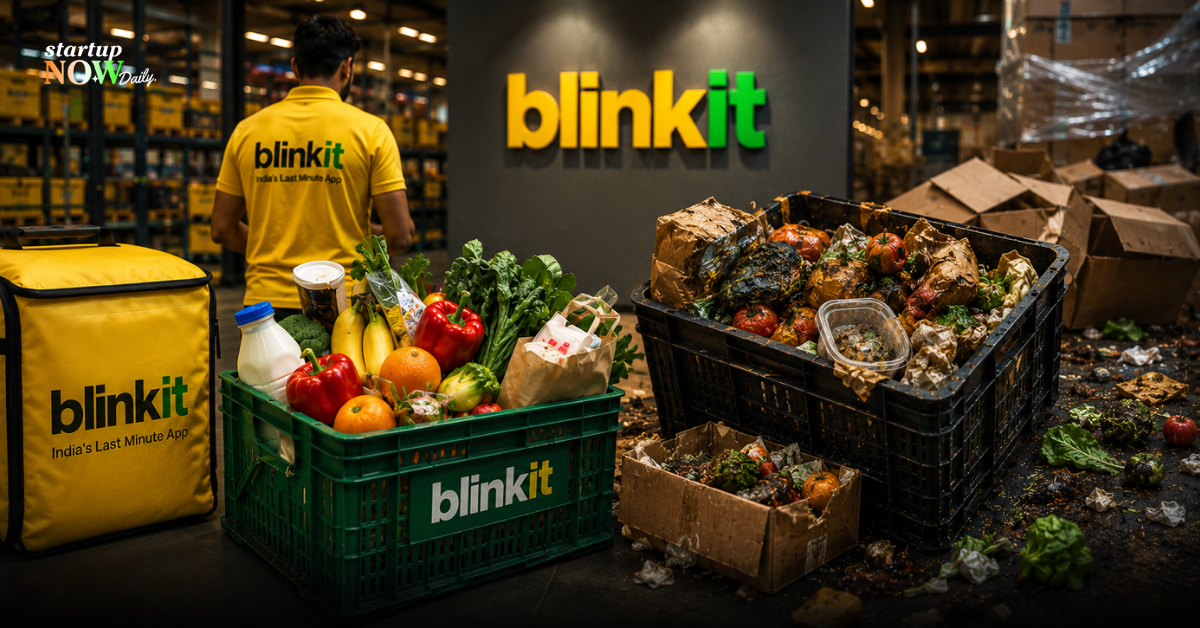
Spoilage, Damaged Goods and Shrinkage Emerge as Major Profit Drag Despite Strong Order Growth
Blinkit, the quick-commerce business of Eternal (formerly Zomato), delivered another quarter of strong operational growth in Q1 FY27, reporting an adjusted EBITDA of ₹102 crore alongside rapid expansion in orders and gross merchandise value. However, a disclosure in the company’s shareholder letter has drawn attention to a significant hidden cost of its inventory-led business model.
According to Blinkit, around 1.8% of its Net Order Value (NOV) is lost due to expired products, damaged inventory, theft, and goods lost during transportation, with fresh fruits and vegetables accounting for a large share of these losses because of their limited shelf life.
Based on Blinkit’s quarterly NOV of ₹17,132 crore, the estimated inventory loss works out to approximately ₹308 crore—almost three times higher than the company’s reported adjusted EBITDA for the quarter.
Where Does the ₹308 Crore Loss Come From?
Blinkit disclosed that the 1.8% inventory loss is already included within its Cost of Goods Sold (COGS).
This means the loss is deducted before the company calculates gross profit, which subsequently feeds into its adjusted EBITDA.
In other words, the reported ₹102 crore adjusted EBITDA is not calculated before inventory losses it represents the profit remaining after absorbing an estimated ₹308 crore in spoilage and shrinkage costs.
The disclosure highlights the operational challenges associated with managing a large-scale inventory business, particularly one dealing with highly perishable products.
Why Are Inventory Losses So High?
Blinkit attributed the losses primarily to:
- Expired food products
- Damaged goods
- Inventory lost during movement
- Theft and shrinkage
Fresh fruits and vegetables contribute significantly because they have shorter shelf lives compared to packaged grocery items.
Quick-commerce companies prioritize rapid delivery and high product availability, often requiring them to maintain substantial inventory levels across hundreds of dark stores.
While this improves customer experience, it also increases the likelihood of unsold inventory, wastage, and operational losses.
Blinkit’s Shift to an Inventory-Led Model
The disclosure also reflects the changing economics of Blinkit’s business.
Earlier, Blinkit primarily operated as a marketplace, connecting buyers with sellers while earning commissions on transactions.
Today, the company follows an inventory-led model, where it purchases products directly, stores them in its own fulfillment centres, and sells them to customers.
This transition has significantly boosted reported revenue because the full value of goods sold is now recognized as revenue rather than just commission income.
As a result, Blinkit’s reported revenue increased 553% year-on-year.
However, the model also shifts inventory risks including spoilage, product damage, and unsold stock onto the company itself.
The ₹308 crore inventory loss illustrates one of the key trade-offs associated with owning inventory rather than operating purely as a marketplace.
Disclosure Raises Questions
Notably, the 1.8% inventory loss figure was disclosed only in Blinkit’s shareholder letter as part of management commentary and does not appear as a separate line item in the company’s audited financial statements.
The company also did not provide comparable figures from previous quarters, making it difficult for investors and analysts to determine whether inventory efficiency is improving or deteriorating over time.
Greater disclosure around inventory performance could become increasingly important as quick-commerce companies continue expanding their physical fulfillment networks.
Store Expansion Continues, But at a Higher Cost
Blinkit is also investing heavily in expanding its dark store network.
According to the shareholder update, the cost of setting up a new store has increased from approximately ₹1 crore to ₹2.5 crore.
Despite the higher capital expenditure, the company added only 200 new stores during the quarter, marking one of its slowest periods of store expansion in recent quarters.
The higher setup costs reflect rising investments in infrastructure, automation, and operational capabilities required to support faster deliveries and wider product selection.
What Does This Mean for Blinkit?
Blinkit’s latest disclosures highlight the balancing act facing India’s quick-commerce sector.
On one hand, strong order growth, increasing revenue, and positive adjusted EBITDA demonstrate continued demand for rapid grocery delivery.
On the other, inventory-led operations introduce new cost pressures that can materially affect profitability.
Managing inventory efficiently particularly fresh produce will remain critical as Blinkit scales its operations across India.
As competition intensifies and companies invest aggressively in expanding their dark store networks, improving inventory management, reducing spoilage, and optimizing fulfillment efficiency are likely to become key drivers of long-term profitability.