
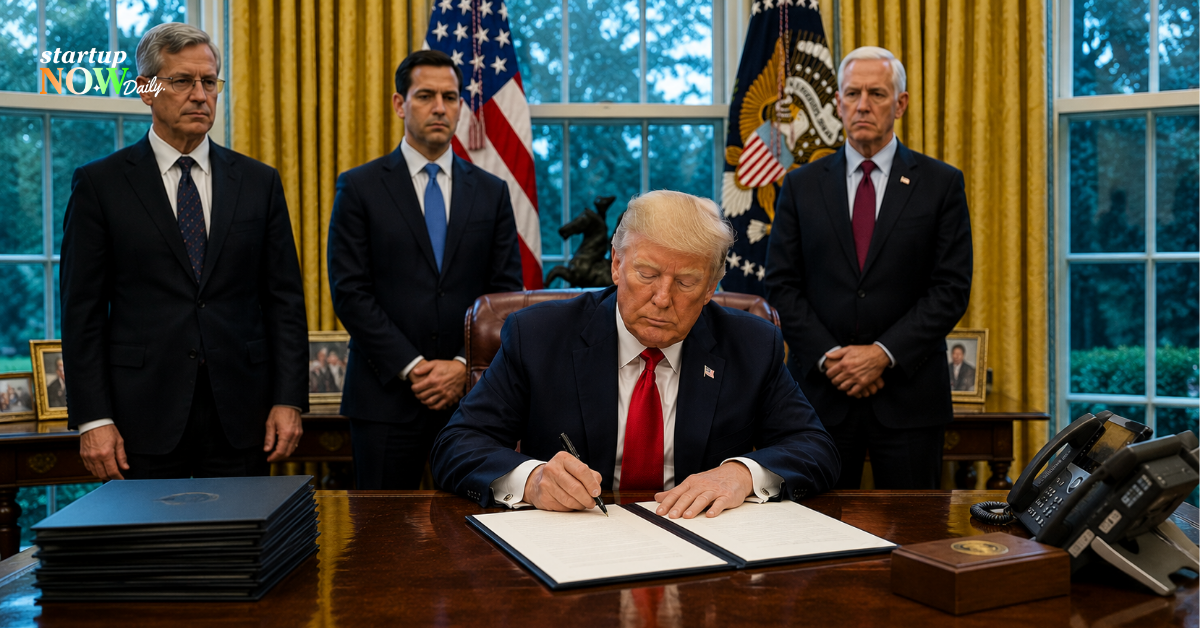
US President Donald Trump has signed a series of executive orders aimed at accelerating quantum computing research, expanding federal adoption of quantum technologies, and strengthening America’s cybersecurity infrastructure against future quantum powered threats.
The move signals a major push by the United States to maintain its leadership in the rapidly emerging quantum technology race, where countries such as China are investing heavily to secure strategic advantages in computing, communications, and national security.
Speaking at the White House, Trump described quantum technology as one of the most important emerging fields of the coming decade.
“We’re already the leader by a lot, and we’re going to be now the leader by a lot more,” Trump said during the signing ceremony.
The event was attended by senior technology leaders, including Ruth Porat, President of Alphabet, and Arvind Krishna, Chief Executive Officer of IBM.
US Targets Quantum Computing Breakthrough By 2028
One of the executive orders launches a federal initiative to build a research focused quantum computer capable of performing scientifically important calculations.
According to White House officials, the administration believes a functional quantum machine meeting these requirements could be developed by 2028.
The initiative will be overseen by the US Department of Energy, which will establish technical specifications for the system. The completed quantum computer is expected to be deployed at a national laboratory or another Energy Department research facility.
While current quantum systems remain largely experimental, scientists believe future quantum computers could solve problems that are impossible for even the most advanced traditional supercomputers.
Federal Agencies To Deploy Quantum Technologies
The executive order also directs federal agencies to begin preparing for broader adoption of quantum-enabled technologies over the next five years.
These include quantum sensors, secure quantum communication networks, and advanced scientific applications.
The administration said it will work closely with allies and private-sector companies to strengthen supply chains, protect quantum intellectual property, and reduce risks associated with foreign competition.
The move is expected to create significant opportunities for US-based quantum technology companies as government demand for advanced systems increases.
Focus On Post-Quantum Cybersecurity
A second executive order focuses on strengthening America’s cybersecurity defenses against future quantum powered cyberattacks.
Experts have long warned that sufficiently powerful quantum computers could eventually break many of today’s encryption standards, potentially exposing financial transactions, government communications, healthcare records, and sensitive corporate data.
To address this threat, the order accelerates the adoption of post-quantum cryptography (PQC), a new generation of encryption algorithms designed to resist attacks from future quantum computers.
Federal agencies have been instructed to complete migration of high-value government systems to post-quantum security standards by 2031 at the latest.
The initiative builds on work already undertaken by the US Department of Commerce, which approved several quantum-resistant encryption algorithms in 2024.
Billions Flow Into Quantum Industry
The executive orders arrive as investor interest in quantum computing continues to surge.
Quantum technology companies have witnessed significant valuation increases over the past year, driven by growing excitement around artificial intelligence and next generation computing.
Earlier this year, the US Commerce Department announced plans to provide more than $2 billion in funding in exchange for non-controlling equity stakes in several quantum technology firms, including IBM and GlobalFoundries.
The administration believes these investments will help accelerate innovation while strengthening domestic technological capabilities.
National Security And Workforce Development
Beyond technology deployment, the orders also emphasize national security and workforce development.
The administration plans to strengthen protections against industrial espionage targeting quantum research while expanding education, apprenticeships, and training programs to create a larger pool of quantum skilled workers.
Officials say building a strong domestic talent pipeline will be critical as demand for quantum engineers, physicists, software developers, and cybersecurity specialists grows over the coming decade.
As global competition intensifies, the latest executive orders position quantum computing as a strategic priority for the United States, with implications that extend far beyond technology into national security, economic competitiveness, and future scientific innovation.