
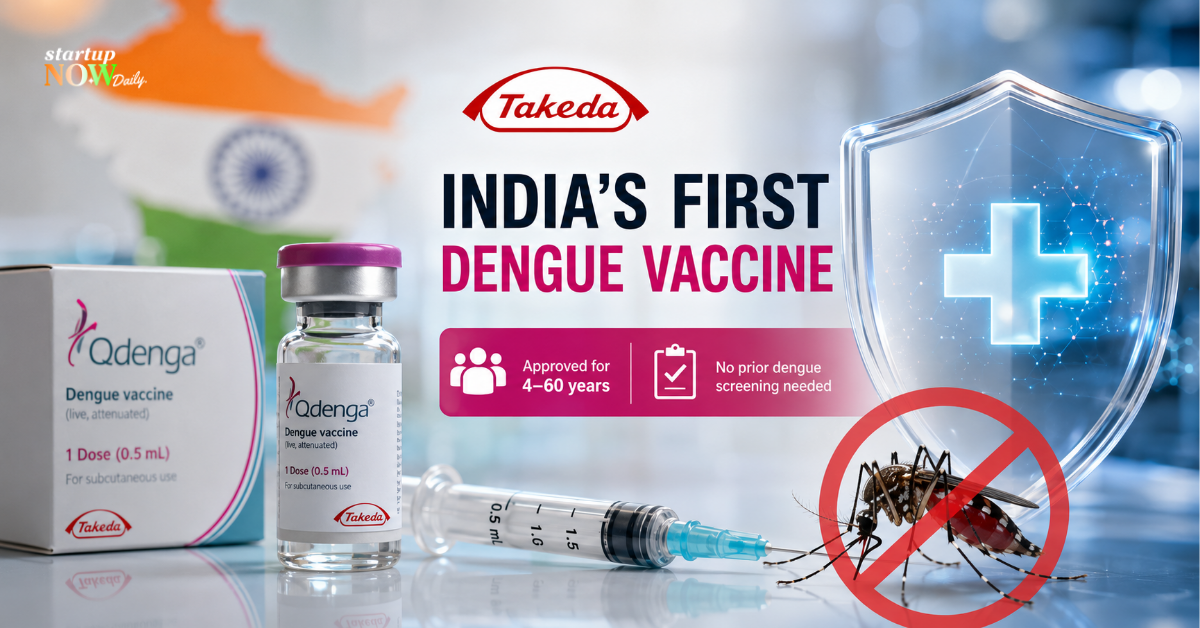
DCGI Clears Two-Dose Vaccine for People Aged 4–60 Years, Marking a Major Milestone in Dengue Prevention
Japan-based Takeda Biopharmaceuticals has received approval from the Drug Controller General of India (DCGI) for its dengue vaccine QDENGA, making it the first vaccine approved in India for the prevention of dengue.
The vaccine has been approved for use in individuals aged 4 to 60 years and can be administered regardless of whether a person has previously been infected with dengue, eliminating the need for pre-vaccination screening.
The approval marks a significant step in India’s fight against one of the country’s fastest growing mosquito borne diseases. Until now, dengue prevention has largely depended on mosquito control measures, surveillance, and public awareness campaigns, while treatment has remained limited to supportive care due to the absence of a specific antiviral therapy.
What Is QDENGA?
QDENGA is a live attenuated tetravalent dengue vaccine developed by Takeda to provide protection against all four dengue virus serotypes.
The vaccine follows a two-dose schedule, with the second dose administered three months after the first.
Unlike some earlier dengue vaccines that required prior infection screening, QDENGA has been approved for eligible individuals irrespective of their dengue infection history, making it easier to integrate into vaccination programmes.
The vaccine is intended to reduce the risk of symptomatic dengue infections as well as severe disease requiring hospitalization.
Why Is This Approval Significant for India?
India continues to face a growing dengue burden, with cases increasing sharply over the past two decades.
According to available data, reported dengue cases have increased more than eleven-fold during this period. More than 113,000 confirmed dengue cases were reported in 2025, although modelling studies suggest the actual number of infections each year could be significantly higher due to underreporting.
The approval of QDENGA introduces India’s first vaccine based strategy for dengue prevention, adding an important public health tool alongside mosquito control and disease surveillance.
Health experts believe vaccination could help reduce severe infections, hospitalisations, and pressure on healthcare systems during seasonal outbreaks.
What Clinical Evidence Supports the Vaccine?
The DCGI approval is backed by Takeda’s extensive global clinical development programme involving more than 28,000 participants across 19 Phase I, II, and III clinical trials.
The company also conducted a Phase III clinical study in India, evaluating the vaccine’s safety and immune response among individuals aged 4 to 60 years.
One of the most significant studies supporting the approval is the TIDES Phase III trial, which enrolled over 20,000 participants across eight dengue-endemic countries.
According to Takeda, the trial demonstrated:
- 80.2% efficacy against laboratory-confirmed dengue one year after the second dose.
- 90.4% efficacy in preventing dengue-related hospitalisation after 18 months.
- 84.1% efficacy against hospitalisation over a follow-up period of 4.5 years.
The company also stated that follow-up studies have shown sustained safety and efficacy for up to seven years, providing long-term evidence supporting the vaccine’s performance.
Global Adoption of QDENGA
Since receiving its first regulatory approval in 2022, QDENGA has expanded rapidly across international markets.
The vaccine has now received regulatory approvals in 43 countries spanning Asia, Europe, and Latin America.
According to Takeda, more than 32 million doses have already been distributed through public and private immunisation programmes worldwide.
QDENGA is currently included in Brazil’s National Immunization Program and is also available through government vaccination programmes in Argentina, Colombia, and Indonesia.
In addition, the vaccine has received World Health Organization (WHO) prequalification, making it eligible for procurement by international organizations such as UNICEF.
The WHO also recommends the vaccine for use in dengue-endemic regions without requiring pre-vaccination screening.
What Happens Next?
Following regulatory approval, Takeda said it will collaborate with Indian regulatory authorities, healthcare professionals, and public health stakeholders to support the rollout and wider availability of QDENGA across the country.
As India continues to battle recurring dengue outbreaks, the introduction of its first approved dengue vaccine represents a major advancement in preventive healthcare.
While mosquito control and public awareness will remain essential components of dengue management, vaccination could become a valuable additional strategy to reduce infections, severe disease, and hospitalisations in the years ahead.