
Parliament’s Monsoon Session Begins Amid Clashes, Demand for Education Accountability and Sonam Wangchuk’s Hunger Strike
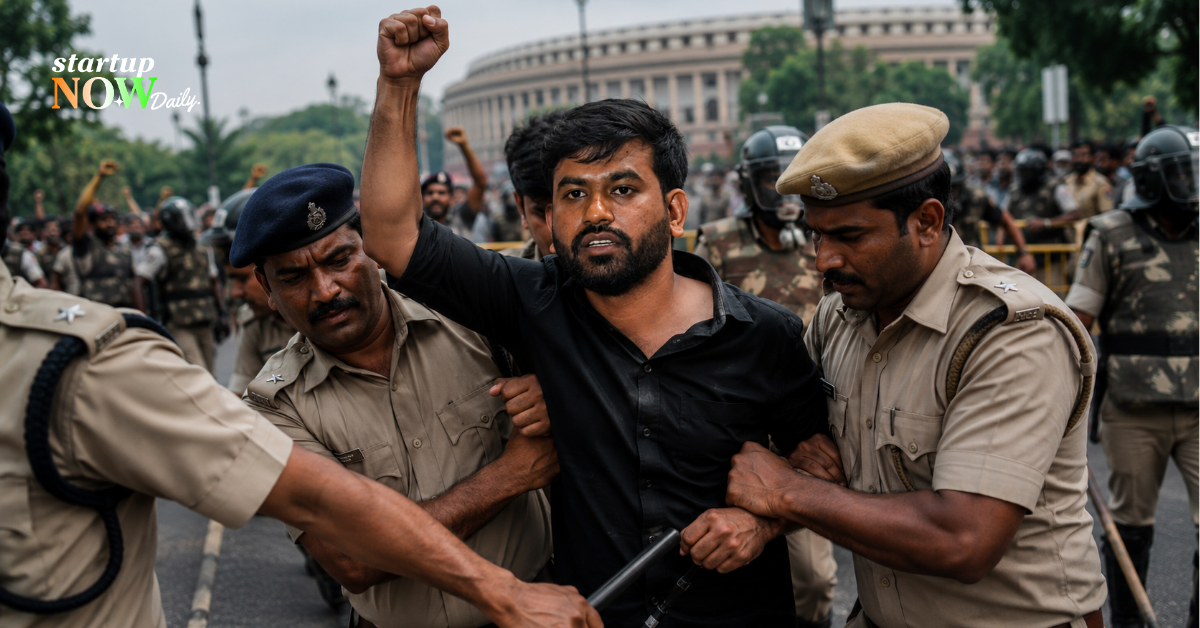
Delhi witnessed widespread protests and heightened security on the opening day of the Monsoon Session of Parliament, as thousands of students and youth participated in the ‘Sansad Chalo’ march led by the Cockroach Janta Party (CJP). The demonstrations, centered on alleged examination irregularities and demands for education reforms, escalated into clashes between protesters and police across several parts of the national capital.
During the protest, CJP founder Abhijeet Dipke was detained by the Delhi Police, according to the organization’s spokesperson. The protest also coincided with activist Sonam Wangchuk’s ongoing hunger strike, which has further amplified calls for education accountability.
Why Did the Protest Take Place?
The demonstrations were organized to demand greater accountability over alleged examination paper leaks and irregularities in competitive examinations.
Protesters also called for the resignation of Union Education Minister Dharmendra Pradhan, arguing that systemic reforms are needed to restore trust in India’s examination system.
The protests gained momentum following Wangchuk’s hunger strike, which has focused on education accountability and parliamentary discussion on reforms during the current Monsoon Session.
Thousands of students, job aspirants, and youth from different states reportedly travelled to Delhi to participate in the march.
Clashes Erupt Across Central Delhi
As protesters attempted to march towards Parliament, police blocked the procession near Connaught Place, forcing demonstrators to take alternate routes through central Delhi.
Clashes broke out at multiple locations, including Constitution Club, Patel Chowk, Shastri Bhawan, Parliament Street, and near the RBI Building, where security personnel used barricades, batons, and tear gas to disperse crowds attempting to move towards Parliament.
Both protesters and police personnel reportedly sustained injuries during the confrontation.
Several groups managed to breach multiple layers of barricades before being stopped by security forces.
Authorities also suspended internet services in parts of central Delhi and tightened access to several nearby metro stations as a precautionary measure, leaving many commuters stranded.
Abhijeet Dipke Detained During March
According to the Cockroach Janta Party, founder Abhijeet Dipke was detained by Delhi Police during the demonstrations.
The organization’s spokesperson alleged that peaceful protesters were subjected to police action and appealed to Members of Parliament to support students demanding education reforms.
Dipke, who has himself been observing a hunger strike following Wangchuk’s hospitalization, reiterated the organization’s key demands, including accountability over examination irregularities, the resignation of the Education Minister, financial assistance for families affected by alleged examination-related tragedies, and Wangchuk’s release.
Police have not issued a detailed public statement regarding the detention.
Sonam Wangchuk Seeks Permission to Join Protest
Meanwhile, Sonam Wangchuk, who remains admitted to Safdarjung Hospital, requested hospital authorities to allow him to temporarily leave the medical facility so he could participate in the Parliament march.
According to Wangchuk, he was feeling physically fit and his health parameters remained stable.
However, hospital authorities stated that while his vital signs were stable, certain blood parameters continued to require close medical observation. He remains under the supervision of a multidisciplinary medical team.
Political Reactions
The protests also echoed inside Parliament, with proceedings in both the Lok Sabha and Rajya Sabha witnessing repeated disruptions as opposition members sought discussions on issues related to education accountability and other matters.
Several opposition leaders criticised the government’s handling of the protests.
Congress leader Shashi Tharoor argued that Parliament should provide adequate space for discussion on issues of public concern, including examination-related controversies.
Aam Aadmi Party national convener Arvind Kejriwal also criticised the police action against protesters and urged the government to engage with the youth rather than respond through force.
Government Reportedly Opens Communication
According to the Cockroach Janta Party, the government has initiated communication with its leadership, and two party spokespersons are expected to meet Union Minister J. P. Nadda to present the organization’s demands.
However, there has been no official confirmation from the government regarding the proposed discussions or any commitments on the issues raised by the protesters.
What Happens Next?
The developments mark one of the largest student-led demonstrations witnessed in the national capital in recent months.
With Parliament now in session, attention will remain focused on whether lawmakers take up the issue of examination reforms and education accountability during legislative proceedings.
The outcome of any discussions between the government and protest representatives could also influence the future course of the ongoing demonstrations, while Wangchuk’s hunger strike continues to remain a central point of the movement.