
Why Is the Micromax-Phison Joint Venture a Milestone for India’s Semiconductor Industry?
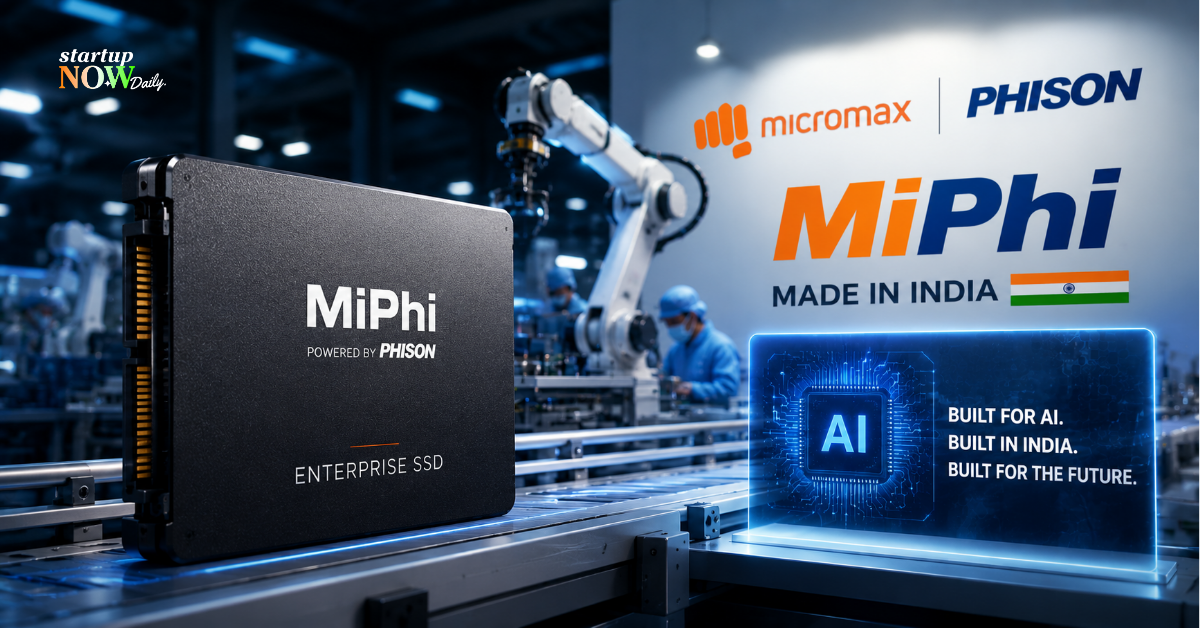
Micromax Informatics, the homegrown consumer electronics company best known for its smartphone business, has entered India’s enterprise semiconductor ecosystem by manufacturing enterprise grade solid state drives (SSDs) through its joint venture with Taiwan’s Phison Electronics. The venture, called MiPhi Semiconductors, has become the first Indian company to manufacture enterprise SSDs locally, marking a significant step in India’s efforts to strengthen its semiconductor and data infrastructure capabilities.
The manufacturing facility, established in Noida, Uttar Pradesh, combines Micromax’s domestic manufacturing expertise with Phison’s global leadership in NAND flash memory controller technology. As demand for artificial intelligence (AI), cloud computing, and data centres accelerates, enterprise storage has emerged as one of the most critical components of modern digital infrastructure.
What Makes Enterprise SSDs So Important in the AI Economy?
Enterprise SSDs are high-performance storage devices designed for data centres, cloud platforms, enterprise servers, and AI workloads. Unlike consumer storage devices, enterprise SSDs are built to handle massive amounts of data with higher reliability, faster speeds, and continuous operation.
As artificial intelligence models become increasingly data-intensive, memory and storage infrastructure have become just as important as computing power. Large AI models require rapid access to enormous datasets, making advanced storage solutions a critical part of AI infrastructure.
Highlighting this shift, Micromax co-founder Rahul Sharma said that memory sits at the top tier of the AI value chain because every increase in computing power also drives demand for faster and larger storage capacity. Developing these capabilities domestically could reduce India’s dependence on imported enterprise storage technologies.
How Does the MiPhi Partnership Combine Indian Manufacturing with Global Technology?
MiPhi Semiconductors was established as a strategic joint venture between Micromax Informatics and Taiwan-based Phison Electronics, with Micromax holding a 55% stake and Phison owning the remaining share.
Phison is globally recognised for designing controllers for NAND flash memory the technology that enables data to be stored even when devices are powered off. By combining Phison’s advanced semiconductor expertise with Micromax’s local manufacturing capabilities, the venture aims to produce enterprise-grade storage products within India for domestic and potentially international markets.
The facility in Noida represents an important example of technology collaboration, where global semiconductor know-how is paired with local manufacturing to accelerate India’s electronics ecosystem.
Why Is Local Manufacturing of Enterprise Storage Strategically Important for India?
India has made semiconductor manufacturing a national priority as part of its broader ambition to strengthen technological self-reliance and build resilient electronics supply chains. While much attention has focused on semiconductor fabrication plants, advanced components such as enterprise SSDs also play a vital role in the country’s digital infrastructure.
Growing investments in AI, cloud computing, digital public infrastructure, financial services, telecom networks, and hyperscale data centres are expected to drive significant demand for enterprise storage solutions in the coming years.
Manufacturing these products domestically can help reduce import dependence, strengthen supply-chain resilience, encourage technology transfer, and support the development of India’s broader semiconductor ecosystem.
What Does This Mean for India’s Technology Manufacturing Ambitions?
The launch of locally manufactured enterprise SSDs signals India’s gradual transition from assembling electronic devices to producing more sophisticated technology components. While the country still imports many advanced semiconductor products, collaborations such as MiPhi demonstrate how Indian companies can move up the technology value chain through strategic global partnerships.
For Micromax, the venture represents a major diversification beyond consumer electronics into enterprise technology infrastructure. For India, it reflects growing momentum toward building domestic capabilities in sectors that will underpin the future of artificial intelligence, cloud services, and digital transformation.
As AI adoption continues to expand across industries, companies capable of manufacturing high-value components such as enterprise SSDs are expected to play an increasingly important role in strengthening India’s position within the global semiconductor ecosystem.