
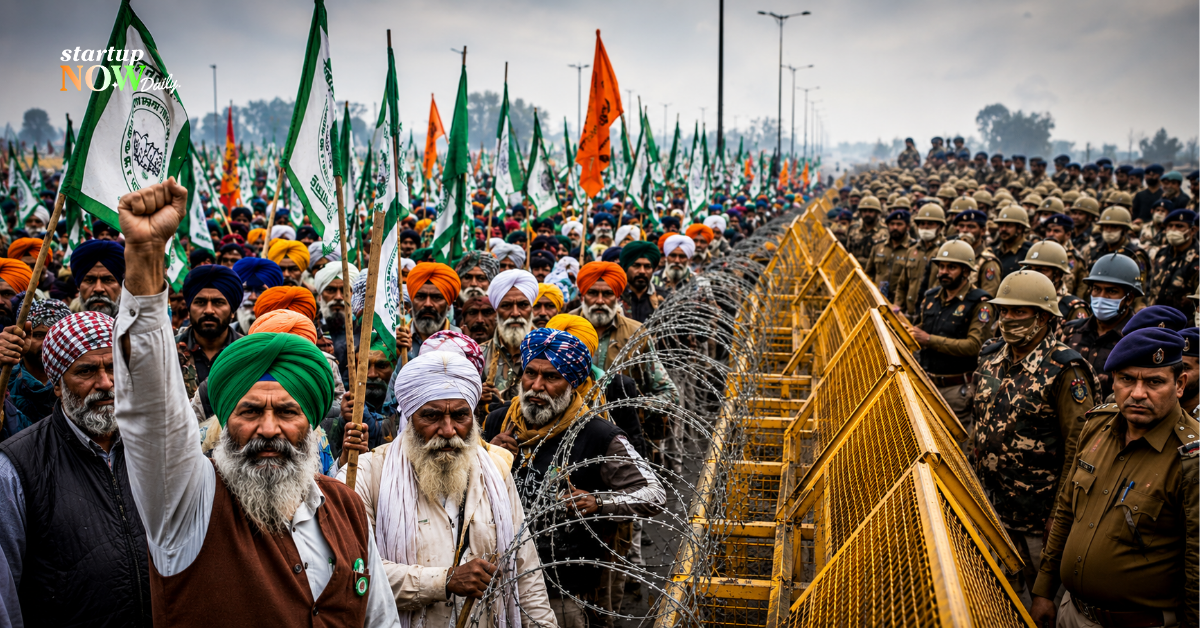
Farmers Protest Proposed India-US Trade Deal; Heavy Security Deployed at Punjab-Haryana Border
The Haryana government on Tuesday tightened security at the Shambhu border between Punjab and Haryana to prevent farmers from travelling to Delhi for the Kisan Mahapanchayat, a day-long gathering organised to protest the proposed India-US trade agreement.
Heavy police deployment, concrete barricades, and cement blocks were placed at the border crossing over the Ghaggar River, restricting the movement of farmers heading towards the national capital. The Mahapanchayat is scheduled to take place at Kisan Ghat in Delhi under the banner of the “Desh Bachao Morcha”, with participants expected from Punjab, Haryana, and several other states.
The protest has emerged as the latest flashpoint over concerns that the proposed trade pact could negatively impact India’s agricultural sector.
Why Are Farmers Protesting?
Farmer organisations have expressed strong opposition to the proposed India-US trade deal, arguing that it could open the Indian market to cheaper agricultural imports.
According to farmer leaders, increased imports may reduce domestic crop prices, weaken farm incomes, and adversely affect agricultural labourers, livestock rearers, small traders, and micro-enterprises dependent on the rural economy.
The protesting groups have urged the Central Government to abandon the proposed agreement, claiming it could undermine the long-term interests of Indian farmers.
They have demanded greater consultation with farmer organisations before any major trade agreement affecting the agricultural sector is finalised.
What Happened at the Shambhu Border?
As farmers began travelling towards Delhi in buses and private vehicles, Haryana Police established extensive security arrangements at the Shambhu border, one of the key entry points between Punjab and Haryana.
Police erected multiple barricades and placed concrete blocks across the bridge over the Ghaggar River to restrict movement.
The measures prevented several groups of farmers from crossing into Haryana as they attempted to continue their journey to the national capital.
Security personnel remained deployed in large numbers to monitor the situation and maintain law and order.
What Did Farmer Leaders Say?
Farmer leader Sarwan Singh Pandher criticised the Haryana government for preventing what he described as a peaceful march to Delhi.
Speaking to reporters before reaching the border, Pandher alleged that the state’s actions contradicted assurances frequently made by Haryana Chief Minister Nayab Singh Saini regarding support for farmers.
Pandher reiterated that farmer organisations are demanding the complete withdrawal of the proposed India-US trade agreement, arguing that it would have long-term consequences for Indian agriculture.
He also stated that the next course of action would be decided after consultations with other farmer leaders gathered near the Shambhu border.
Farmers Begin Journey Towards Delhi
The farmers’ convoy began its journey from Gurdwara Sri Fatehgarh Sahib in Punjab after more than 1,000 farmers spent the previous night at the gurdwara’s pilgrims’ accommodation.
The procession travelled through Madhopur near Sirhind before heading towards the Shambhu border on the Grand Trunk Road.
Farmer organisations had earlier announced that participants from multiple districts across Punjab would travel together to attend the Mahapanchayat in Delhi.
The event is expected to bring together representatives from several farmer unions to discuss the proposed trade agreement and future protest strategies.
Previous Detentions Add to Tensions
The developments come shortly after Bharatiya Kisan Union (Charuni) chief Gurnam Singh Charuni was detained by Haryana Police while travelling towards Delhi ahead of the planned Mahapanchayat.
Representatives of the organisation alleged that numerous workers had also been detained to prevent their participation in the protest.
The detentions and heightened security have further intensified tensions between protesting farmer groups and the state administration.
Why Does the Trade Deal Matter?
Although details of the proposed India-US trade agreement are yet to be officially finalised, farmer organisations fear that expanded market access for imported agricultural products could place additional pressure on domestic producers.
Agricultural groups argue that lower-priced imports may affect crop profitability, rural employment, and allied sectors such as livestock and small-scale food processing.
Supporters of the agreement, however, contend that trade partnerships can expand export opportunities and strengthen economic ties, although negotiations remain ongoing.
What Happens Next?
With security tightened at border points and thousands of farmers attempting to reach Delhi, attention now shifts to whether the Kisan Mahapanchayat proceeds as planned and whether discussions between farmer organisations and the government take place.
Farmer unions have indicated that they will continue consultations to determine their next steps if restrictions on movement remain in place.
The protest also highlights the continued sensitivity of agricultural policy and international trade negotiations, with farmer organisations seeking greater involvement in decisions that could significantly impact India’s rural economy.