
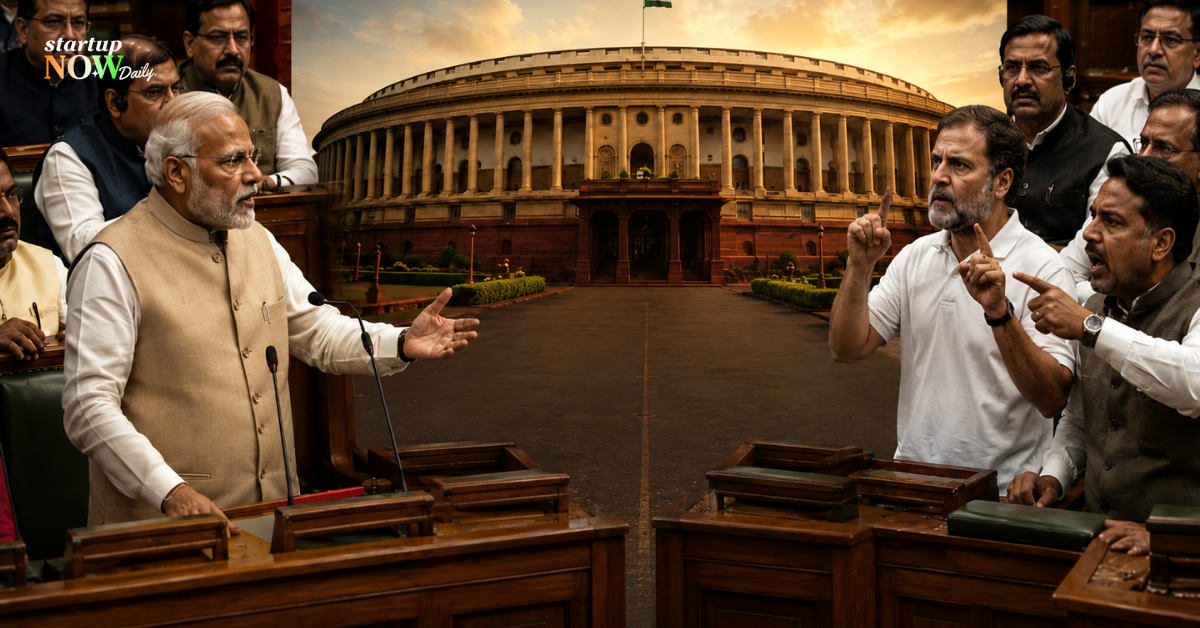
Government Ready for NEET Discussion, Congress Says Debate Must Follow Education Minister’s Exit
The deadlock in Parliament over the alleged NEET paper leak controversy entered its third consecutive day on Wednesday, with the government expressing its willingness to hold a discussion on the issue while the Opposition remained firm on its demand that Union Education Minister Dharmendra Pradhan resign before any debate takes place.
The Congress-led Opposition argued that Pradhan’s resignation is essential to ensure an impartial discussion and accountability over alleged irregularities in the conduct of the National Eligibility cum Entrance Test (NEET).
The ongoing political impasse has disrupted proceedings during the Monsoon Session, with both sides refusing to soften their positions.
Government Says It Is Ready for Debate
Addressing a press briefing, Union Minister and Rajya Sabha Leader of the House J.P. Nadda said the government is fully prepared to discuss the issue of examination paper leaks in Parliament.
He accused the Opposition of attempting to derive political mileage from the controversy instead of participating in a constructive debate.
Defence Minister Rajnath Singh also urged Opposition parties to raise their concerns inside Parliament rather than through protests on the streets.
However, the Opposition maintained that a meaningful discussion cannot take place while the minister responsible for the education portfolio remains in office.
Rahul Gandhi Backs Student Protesters
Leader of Opposition Rahul Gandhi held a press conference in New Delhi, extending full support to protesting students and calling their demands “legitimate.”
He alleged that India’s education system is facing a deep crisis marked by repeated examination paper leaks, rising educational costs, and declining employment opportunities.
According to Gandhi, students are not demanding special treatment but a transparent and fair examination system.
He also reiterated the Opposition’s demand for the resignation of Education Minister Dharmendra Pradhan, describing it as a necessary step toward restoring public confidence.
Gandhi further alleged that over 150 examination paper leaks had occurred over the past decade, affecting millions of students, while calling for accountability and systemic reforms.
Sonam Wangchuk Continues Hunger Strike
Meanwhile, climate activist Sonam Wangchuk, whose hunger strike entered its 25th day, issued a video message from Medanta Hospital after being shifted there following a Delhi High Court order.
Wangchuk confirmed that J.P. Nadda and Union Minister Jitendra Singh had met him at the hospital.
He said he remains willing to end his indefinite fast if the government agrees to key demands, including:
- No use of force against protesting students.
- No legal or punitive action against participants in the protests.
- Compensation for families of students who allegedly died by suicide following examination paper leak controversies.
- A parliamentary discussion ensuring accountability in the education system.
CJP Maintains Pressure on Government
The Cockroach Janata Party (CJP), which has been leading the student movement, reiterated that its protests would continue until Education Minister Dharmendra Pradhan is removed from office.
CJP founder Abhijeet Dipke stated that the movement would not end until the minister is dismissed by Prime Minister Narendra Modi.
The organisation also demanded legal action against police personnel accused of using excessive force during the recent Sansad Chalo protest.
While expressing willingness to engage in dialogue with the government, CJP leaders insisted that discussions should take place either at Jantar Mantar or another neutral venue rather than at a minister’s residence.
High Court Seeks Response on Police Action
The controversy surrounding police action against protesters also reached the judiciary.
The Delhi High Court sought responses from both the Centre and Delhi Police on petitions alleging excessive use of force during Monday’s march toward Parliament.
Student protesters and Opposition leaders have accused security personnel of using disproportionate force during the demonstrations, allegations that Delhi Police have denied.
The protests also caused significant disruption across the national capital, with 16 Delhi Metro stations temporarily closed due to security concerns before services resumed later in the day.
Political Tensions Continue
The NEET controversy has evolved into a major political confrontation, extending beyond examination reforms to broader questions of government accountability, student welfare, and public trust in India’s education system.
While the government has indicated its readiness for a parliamentary debate, the Opposition remains unwilling to participate unless its demand for the Education Minister’s resignation is accepted.
With protests continuing across the country and Parliament repeatedly witnessing disruptions, the issue is expected to remain one of the central political flashpoints of the ongoing Monsoon Session.