
Division Bench Permits Shift to Hospital of Choice Amid Ongoing Hunger Strike and Health Monitoring
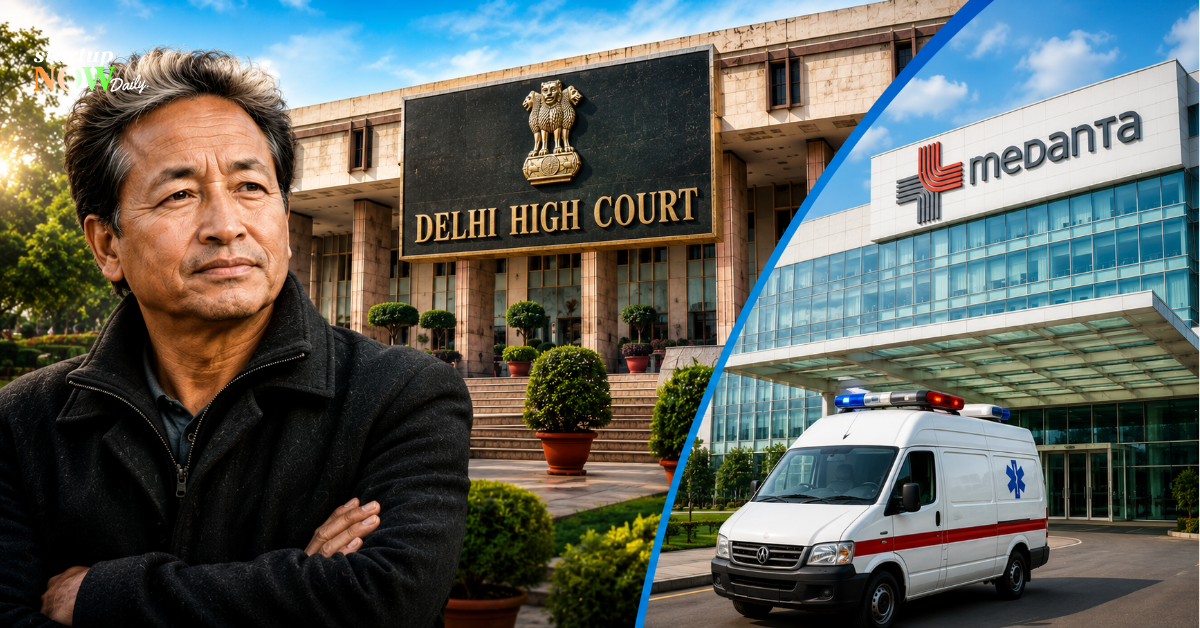
The Delhi High Court on Tuesday permitted activist Sonam Wangchuk to be shifted from Safdarjung Hospital to Medanta Hospital in Gurugram, allowing him to continue receiving treatment under the supervision of doctors at the private healthcare facility.
The order was passed by a Division Bench comprising Chief Justice Devendra Kumar Upadhyaya and Justice Tejas Karia, while hearing an appeal filed by Wangchuk’s wife, Gitanjali Angmo, challenging an earlier single-judge decision that had declined to order his transfer.
The court observed that Wangchuk could receive treatment at the hospital of his choice while ensuring that continuous medical monitoring remains in place.
Why Was the Appeal Filed?
The appeal was moved after a single judge of the High Court refused to grant interim relief directing Wangchuk’s transfer from Safdarjung Hospital.
Gitanjali Angmo argued that the family had lost confidence in the treatment being provided at the government hospital due to an alleged lack of transparency regarding his medical reports and treatment.
She also contended that Wangchuk’s continued stay at Safdarjung Hospital amounted to an unlawful restriction on his liberty and that, as a competent adult, he had the constitutional right to choose where he wished to receive medical treatment.
The appeal further argued that Article 21 of the Constitution, which guarantees the right to life and personal liberty, includes the right to bodily autonomy and the freedom to decide one’s medical treatment.
Court Reviews Wangchuk’s Medical Condition
During the hearing, the Division Bench examined Wangchuk’s medical reports submitted by Safdarjung Hospital, the All India Institute of Medical Sciences (AIIMS), and other treating doctors.
Senior Advocate Akhil Sibal, appearing for Gitanjali Angmo, submitted additional medical records from Wangchuk’s treating physician.
The Centre, represented by Additional Solicitor General Chetan Sharma, also placed medical documents before the court.
The Bench questioned doctors regarding changes in Wangchuk’s medical condition, particularly his potassium levels, as well as increasing urea and uric acid levels following his prolonged fast.
Doctors informed the court that such biochemical changes are commonly observed during extended fasting as the body begins utilizing stored fat for energy, resulting in the production of ketones.
Court Approves Transfer to Medanta
After reviewing the medical evidence and interacting with doctors, the Bench observed that there was broad agreement among medical experts that Wangchuk required continuous monitoring but could safely be shifted.
The court stated that Wangchuk would be transferred to Medanta Hospital, where a dedicated panel of doctors would oversee his treatment.
It also directed that all medical records and treatment details from Safdarjung Hospital be immediately shared with Medanta to ensure continuity of care.
The Bench indicated that a formal written order would be issued after the court session.
Importantly, the Central Government informed the court that it had no objection to Wangchuk’s transfer.
Background of the Case
Sonam Wangchuk has been on an indefinite hunger strike since June 28 in support of the student-led Cockroach Janata Party (CJP) movement, which has been demanding accountability over repeated examination paper leaks and seeking reforms in the education system.
On July 18, Delhi Police shifted Wangchuk from the protest site at Jantar Mantar to Safdarjung Hospital after expressing concerns over his health due to the prolonged fast.
The following day, Gitanjali Angmo approached the High Court seeking permission to transfer him to a private hospital, arguing that the family no longer had confidence in the treatment being provided.
She also alleged that restrictions placed on Wangchuk’s movement, communication, and visitors effectively amounted to illegal detention.
What Happens Next?
With the High Court allowing the transfer, Wangchuk will now continue his treatment at Medanta Hospital under the supervision of a specialist medical team while remaining under continuous observation.
The decision comes amid heightened public attention surrounding his hunger strike and the broader student-led protests demanding education accountability.
Although the transfer resolves the immediate dispute regarding his medical treatment, the legal and political issues surrounding his protest continue to attract national attention.
The case also raises broader constitutional questions relating to a person’s right to choose medical treatment, personal liberty, and the balance between state intervention and individual autonomy during prolonged protests involving health risks.