
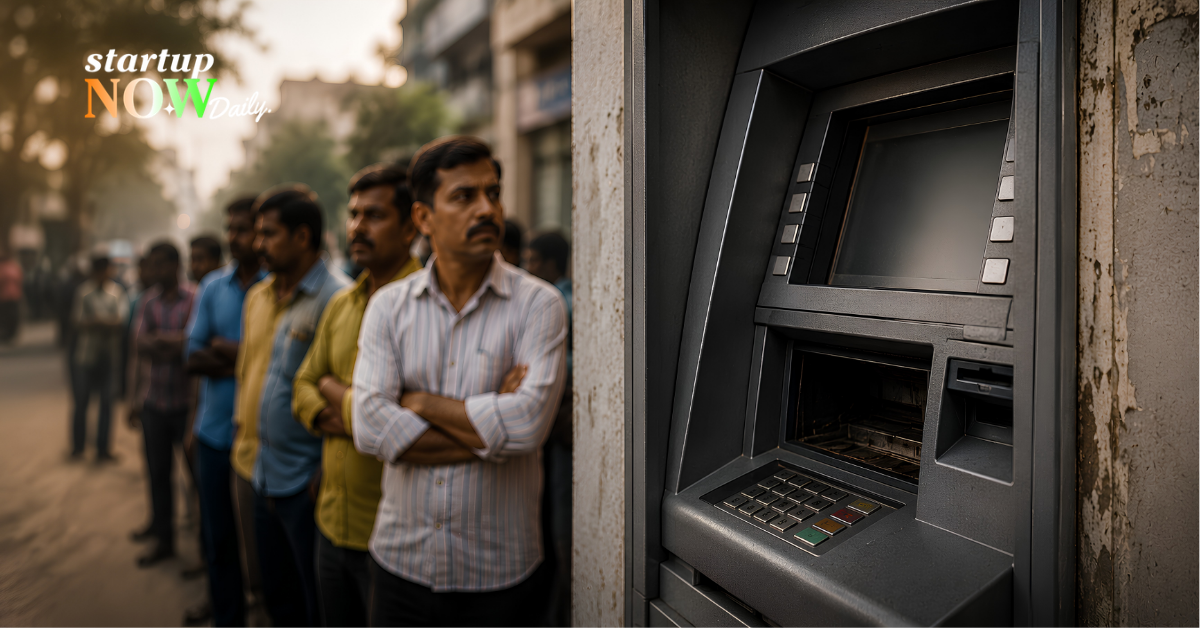
Despite ₹42.5 Trillion In Circulation, ATM Networks Are Running Short Of Cash
Nearly a decade after demonetisation reshaped India’s payments landscape, a surprising problem has resurfaced: ATMs are struggling to stay stocked with cash.
Recent industry data shows that while banks and ATM operators intended to load around ₹94,000 crore into ATMs during March and April, the actual cash available for replenishment stood at just ₹61,000 crore and ₹54,000 crore, respectively. This translated into fulfillment rates of only 64% in March and 57% in April.
The shortfall is particularly striking because India’s currency in circulation (CiC) continues to grow rapidly. As of May 22, cash circulating in the economy stood at ₹42.54 trillion, up 12% year-on-year and equivalent to nearly 12% of the country’s GDP.
The disconnect raises an important question: If there is so much cash in the system, why are ATMs running dry?
The Problem Isn’t Cash. It’s Cash Distribution.
At first glance, the numbers appear contradictory. However, banking experts say currency in circulation should not be confused with cash readily available for ATM replenishment.
CiC represents the total amount of cash outside RBI-managed currency chests and circulating across households, businesses, and financial institutions. It does not indicate how much cash is immediately accessible to banks and ATM operators for distribution.
In other words, India may have plenty of cash in the economy, but moving that cash efficiently through the ATM network has become increasingly challenging.
Rising Logistics Costs Are Squeezing The Ecosystem
Industry participants point to a growing mismatch between operational costs and revenues.
Cash-in-transit (CIT) companies, which transport money between currency chests, bank branches, and ATMs, are facing sharply higher expenses due to rising fuel prices, security requirements, insurance costs, and workforce expenses.
However, the interchange fees and compensation structures that support ATM operations have remained largely unchanged.
This has created mounting pressure across the cash management ecosystem, with banks, ATM service providers, and CIT firms all attempting to protect margins in an increasingly expensive operating environment.
As a result, ATM replenishment efficiency has suffered despite strong cash demand.
Digital India Still Runs On Cash
The ATM shortage also highlights a reality often overlooked amid India’s digital payments boom.
UPI transactions may be setting global records, but cash remains deeply embedded in the economy. Small businesses, rural communities, informal workers, and millions of consumers continue to rely heavily on physical currency for everyday transactions.
The steady rise in currency circulation demonstrates that India’s transition to a cash-light economy is far from complete.
In fact, the continued growth of cash usage suggests that digital and physical payment systems are expanding simultaneously rather than replacing one another.
A Structural Challenge Ahead
The current ATM cash shortage is less about a lack of money and more about the economics of moving money.
Without improvements in cash logistics infrastructure, revised compensation structures, and stronger coordination between banks and service providers, the gap between cash demand and ATM availability could persist.
As India approaches the tenth anniversary of demonetisation, the episode serves as a reminder that even in the age of UPI and digital wallets, maintaining an efficient cash distribution network remains critical to the functioning of the economy.