
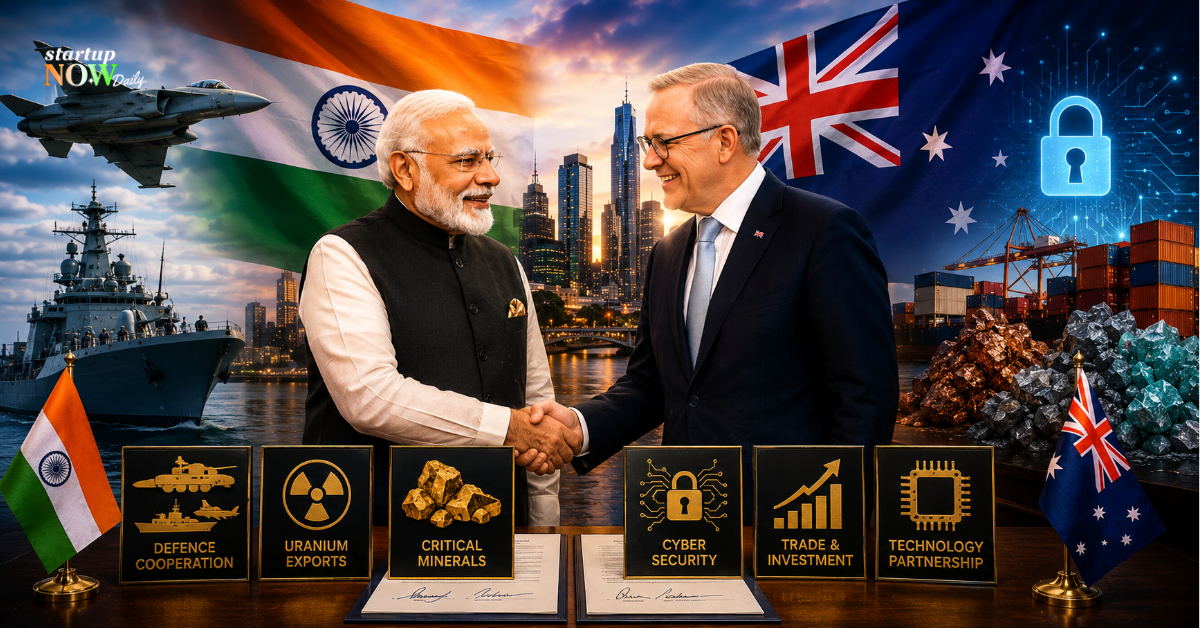
Modi-Albanese Summit Delivers Major Agreements on Defence, Uranium, Critical Minerals and Cyber Security
India and Australia have significantly expanded their strategic partnership with a series of agreements covering defence, energy security, critical minerals, cyber security, trade, space, and education during the third India-Australia Annual Summit held in Melbourne. The announcements came after bilateral talks between Prime Minister Narendra Modi and Australian Prime Minister Anthony Albanese, underscoring the growing importance of the relationship in the Indo-Pacific region.
The summit resulted in multiple agreements aimed at strengthening economic cooperation, enhancing defence collaboration, securing critical supply chains, and accelerating clean energy partnerships, reflecting the deepening strategic alignment between the two countries.
Defence Partnership Receives Major Boost
One of the summit’s most significant outcomes was the signing of the Australia-India Joint Declaration on Defence and Security Cooperation (2026).
The agreement expands cooperation across defence, maritime security, defence manufacturing, critical technologies, and regional stability.
Both countries also agreed to establish an annual Defence Ministers’ Dialogue while increasing coordination between their armed forces.
In addition, India and Australia endorsed the India-Australia Maritime Security Collaboration Roadmap, reinforcing their shared commitment to maintaining a free, open, and secure Indo-Pacific.
The two nations also signed a Memorandum of Understanding (MoU) between Australia’s Maritime Border Command and the Indian Coast Guard to strengthen maritime coordination and enhance regional security.
Shared Vision for the Indo-Pacific
Prime Minister Modi and Prime Minister vreaffirmed their commitment to maintaining a free, open, inclusive, and rules-based Indo-Pacific.
Both leaders emphasized the importance of freedom of navigation, peaceful resolution of disputes, and adherence to international law, including the United Nations Convention on the Law of the Sea (UNCLOS).
The two countries also agreed to deepen cooperation through the Indian Ocean Rim Association (IORA), including maritime safety initiatives, search-and-rescue operations, and collaboration under the Indo-Pacific Oceans Initiative.
India and Australia further committed to strengthening cooperation through the Australia-India-Indonesia trilateral framework, focusing on maritime awareness, blue economy initiatives, and marine pollution management.
Australia Clears Uranium Exports to India
A major breakthrough came in the field of civil nuclear cooperation.
The two governments signed the administrative arrangement required to operationalize the Australia-India Nuclear Cooperation Agreement, enabling Australia to begin supplying uranium for India’s civilian nuclear programme under International Atomic Energy Agency (IAEA) safeguards.
Australia also reiterated its support for India’s membership of the Nuclear Suppliers Group (NSG).
The agreement is expected to strengthen India’s clean energy ambitions by supporting the expansion of nuclear power generation while opening a new export market for Australia’s uranium sector.
Critical Minerals and Energy Security in Focus
Critical minerals emerged as another major pillar of the bilateral partnership.
Both countries agreed to strengthen collaboration across exploration, investment, processing, and long-term supply arrangements for critical minerals essential to clean energy technologies and advanced manufacturing.
The leaders also issued a joint statement on energy security, expressing concern over geopolitical instability affecting global energy markets.
India and Australia reaffirmed their commitment to rules-based trade, uninterrupted energy supplies, renewable energy cooperation, electrification, and resilient critical mineral supply chains.
The agreements aim to strengthen long-term energy security while supporting both countries’ transition toward cleaner energy sources.
Trade, Technology and Cyber Cooperation Expand
The two leaders welcomed growing bilateral trade under the India-Australia Economic Cooperation and Trade Agreement (ECTA) and reiterated their commitment to concluding the broader Comprehensive Economic Cooperation Agreement (CECA).
Both sides also supported greater investment flows, stronger financial sector collaboration, and closer engagement between private enterprises.
A key announcement was the launch of the Australia-India Partnership on Cyber, Critical Technologies and Supply Chains (PACTS).
The new framework replaces the earlier cyber cooperation arrangement and expands collaboration across cyber security, emerging technologies, digital resilience, defence research, and secure supply chains.
The summit also welcomed the Australia-Canada-India Technology and Innovation (ACITI) Partnership, aimed at promoting cooperation in trusted and advanced technologies.
Space, Education and People-to-People Ties
Space cooperation also received fresh momentum.
Australia reaffirmed support for India’s Gaganyaan human spaceflight mission, including the establishment of a temporary tracking station on the Cocos (Keeling) Islands.
Both countries also agreed to strengthen collaboration between the Indian Space Research Organisation (ISRO) and the Australian Space Agency.
In education, Australia announced an additional A$10 million for the Centre for Australia-India Relations’ Maitri Grants Programme, aimed at expanding academic, cultural, and business exchanges.
The leaders welcomed the establishment of Flinders University in Bengaluru and Victoria University in Gurugram, while also supporting the creation of a National Centre of Excellence for Skilling in Mining in Odisha.
The summit also highlighted the growing contribution of the Indian diaspora, now Australia’s largest overseas-born community, as a key pillar of the bilateral relationship.
A Comprehensive Strategic Partnership
The third India-Australia Annual Summit marks another significant step in the evolution of the Comprehensive Strategic Partnership between the two democracies.
From defence and maritime security to energy, technology, trade, education, and critical minerals, the agreements reflect an increasingly broad and strategic relationship.
As geopolitical and economic dynamics continue to evolve across the Indo-Pacific, India and Australia appear committed to building a long-term partnership focused on regional stability, resilient supply chains, clean energy, and sustainable economic growth.
Follow Startup Now Daily for the latest updates on business, policy, global affairs, startups, technology, and India’s rapidly evolving economy.