
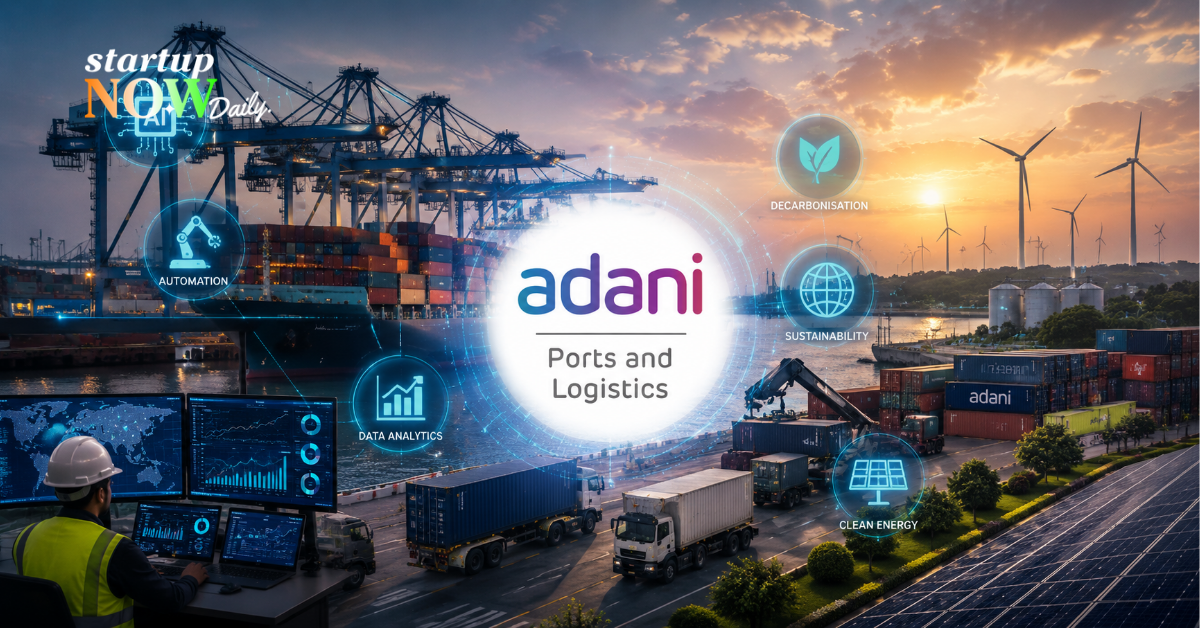
Adani Ports Bets Big On AI, Automation And Sustainability
India’s largest private port operator, Adani Ports and Special Economic Zone (APSEZ), has announced an ambitious $850 million investment plan focused on technology upgrades, decarbonisation initiatives and capacity expansion as it works towards its long-term goal of handling one billion tonnes of cargo annually by 2030.
A key component of the strategy includes an investment of up to $100 million in partnership with US-based logistics technology company Kaleris to deploy artificial intelligence-driven automation and optimisation solutions across APSEZ’s vast port network.
The move underscores how global port operators are increasingly turning to AI, automation and digital infrastructure to improve efficiency, reduce emissions and manage rising cargo volumes.
Why Is Adani Ports Investing In AI?
As global supply chains become more complex and cargo traffic continues to rise, ports face mounting pressure to improve operational efficiency while reducing costs and turnaround times.
APSEZ believes artificial intelligence will become a critical competitive advantage in the logistics industry over the coming decade.
The company has expanded its strategic partnership with Kaleris, a leading provider of cloud-based supply chain execution and visibility solutions, to build next-generation operational capabilities across its domestic and international ports.
The multi-year agreement will see Kaleris deploy its advanced terminal operating systems and AI-powered optimisation tools across 15 container terminals spanning nine ports.
According to APSEZ, the initiative will improve real-time decision-making, resource allocation, cargo visibility and overall port productivity.
What Will The Kaleris Partnership Deliver?
The technology deployment is expected to significantly enhance operational performance across APSEZ’s network.
Building on earlier implementations at six ports, the next phase will introduce advanced planning, optimisation and automation capabilities across all major container terminals.
According to the company, the deployment could generate measurable productivity gains, including:
- Up to 20% improvement in Rubber Tyred Gantry (RTG) crane productivity
- Up to 14% improvement in terminal truck productivity
- Faster vessel turnaround times
- Improved yard utilisation
- Better planning accuracy
- Enhanced cargo movement predictability
These improvements are expected to strengthen APSEZ’s ability to handle larger cargo volumes without proportionally increasing operating costs.
AI Becomes Central To Adani Ports’ Growth Strategy
The investment highlights APSEZ’s growing focus on digital transformation.
The company has already built an end-to-end digital platform that enables track-and-trace capabilities across its logistics ecosystem. The new AI-powered infrastructure will further strengthen this platform by integrating automation and predictive decision-making tools.
Ashwani Gupta, Whole-Time Director and CEO of APSEZ, said AI-enabled automation represents the next frontier of competitiveness in the ports and logistics sector.
According to Gupta, the expanded partnership will help improve operational productivity while delivering a better customer experience through faster and more reliable cargo handling.
The initiative aligns with a broader trend among global port operators that are increasingly investing in intelligent logistics systems to improve efficiency and resilience.
How Does This Fit Into APSEZ’s 2030 Vision?
The technology investment forms part of APSEZ’s broader ambition to create a highly automated and sustainable logistics network.
The company aims to build cargo-handling capacity of one billion tonnes annually by 2030, significantly expanding its current capabilities.
To achieve this goal, APSEZ is investing heavily in multiple emerging technologies, including:
- Artificial Intelligence (AI)
- Internet of Things (IoT)
- Computer Vision
- Advanced Analytics
- Automation Platforms
- Smart Resource Allocation Systems
These technologies are expected to provide real-time operational visibility while enabling faster responses to changing cargo flows and customer requirements.
Decarbonisation Remains A Key Priority
Beyond operational efficiency, a substantial portion of the $850 million investment will be directed toward sustainability and decarbonisation initiatives.
Ports worldwide face increasing pressure to reduce carbon emissions as governments, investors and customers prioritize environmental performance.
By integrating smarter automation systems, APSEZ expects to improve equipment utilisation, reduce idle times and optimise energy consumption across its facilities.
The company views digitalisation and sustainability as complementary objectives that can simultaneously improve profitability and environmental outcomes.
Why This Matters For India’s Logistics Sector
As India’s trade volumes continue to expand, the efficiency of port infrastructure will play a crucial role in supporting economic growth.
Faster cargo handling, lower turnaround times and improved logistics visibility can reduce supply chain costs and improve India’s competitiveness in global trade.
The APSEZ-Kaleris partnership represents one of the largest AI-led digital transformation initiatives in the country’s maritime sector and signals the increasing role technology will play in future logistics operations.
With cargo volumes expected to rise steadily over the coming years, investments in automation, optimisation and sustainability could help position APSEZ among the world’s most technologically advanced port operators.
For Adani Ports, the $850 million investment is not just about expanding capacity it is about building the digital foundation required to manage the next generation of global trade.